My Royal Nemesis: A Kdrama Fashion Data Breakdown Nobody Asked For.
I had completed watching the viral Korean drama My Royal Nemesis and safe to say it was captivating from start to finish. What captivated me more besides the superior casting is the outfits worn by the character Shin Seo Ri played by Lim Ji Yeon. After completing a Kdrama, I always ran to my favorite website inkistyle.com who does exceptional work in compiling what each character is wearing in each episode. I have decided to do a fun analysis from and coded the outfits that appeared in all 14 episodes to the best of my ability. The limitation is that it may not contain the full information; my analysis is based on what is listed on inkistyle.com, which is widely used as the standard reference for K-drama fashion.
The most interesting thing I discovered is that out of 53 outfits, 72% of them are local Korean brands with the remaining being Western brand. To be honest it is refreshing to see that. In previous years, most Korean dramas mainly tap into Western brands with big price tag. My Royal Nemesis on the other hand has embraced their local brands and providing exposure and opportunities to these brands to shine.
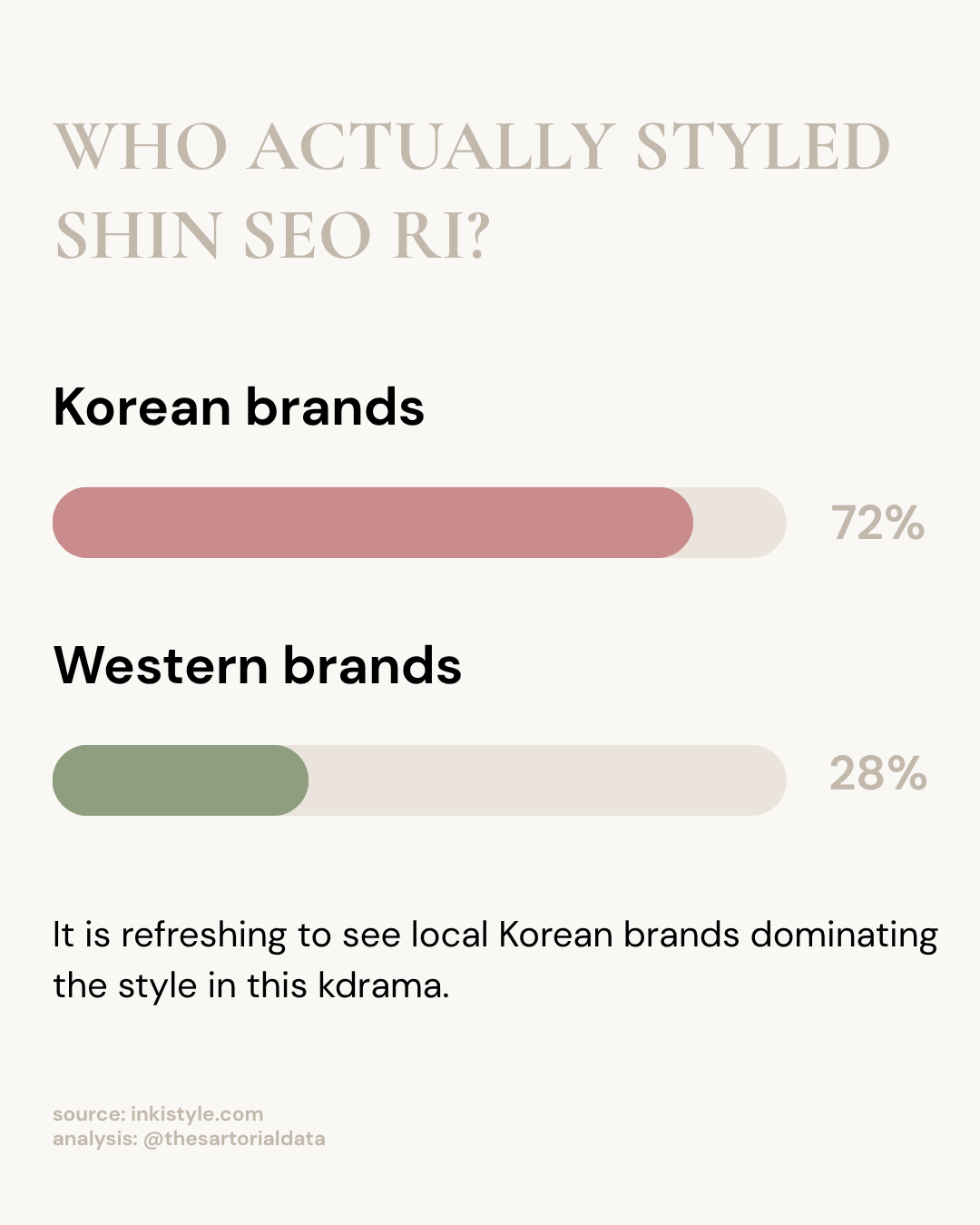
Image showing chart to show the percentage breakdown of local Korean brands and western brands in the kdrama.
If you were to be Shin Seo Ri, the total wardrobe would cost more than $10,000 which is unrealistic for an everyday office hustler. What is worth mentioning though that if the character were my friend, we would shop at the same places. Her wardrobe consist of familiar and attainable brands such as Zara and my all time favorite Sézane. Being able to see clothes from familiar brands on the wide screen gives a sense of comfort in a current economy where it feels like you can’t buy anything. Is this Korean entertainment industry’s way of closing the gap with its viewers?
Did the costume department get it right by dressing the character in attainable fashion? Given that she’s portrayed as a struggling actress, it makes sense that her wardrobe avoids high-end labels. Inaccurate costume choices like a supposedly broke character carrying a $6,500 luxury handbag have drawn criticism in past dramas for breaking immersion. Realistic, budget-conscious styling helps maintain credibility and deepen the character’s story. Although Seo Ri wears luxury outfits in some scenes, the story about a struggling actress whose soul was swapped, who becomes a better actress and gradually gains fame makes it believable that those clothes are sponsored.
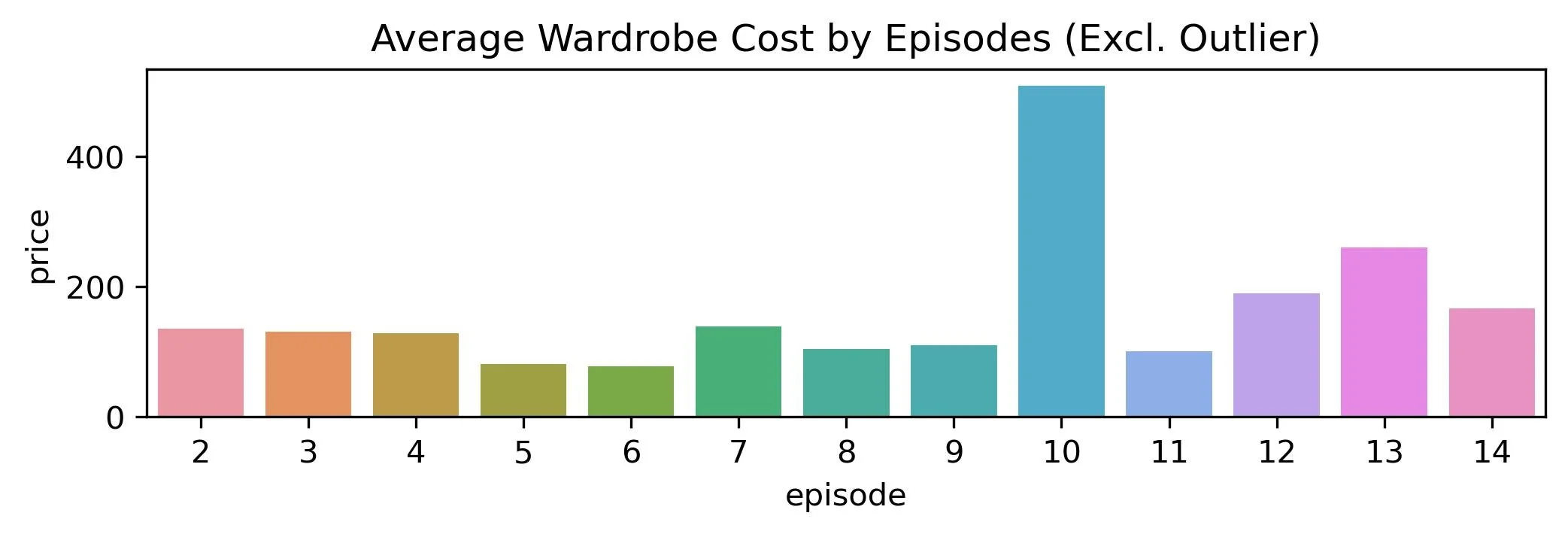
Image extracted from my Python analysis on Jupyter Notebook on average wardrobe cost by episodes excluding outlier
The highest item in Seo Ri’s wardrobe is a handbag from Colombo that cost more than $8,000. That was an outlier to the range in her wardrobe cost. By excluding this bag, on average, Shin Seo Ri’s wardrobe cost around $172 to which is still high in my opinion.
However, if we examine quality, intentionally designed, and long-lasting pieces, the average cost still proves to be more economical than buying cheaper items that only last a short time. I personally think that should be direction in fashion. Intentional and quality purchase.
The thing I wished I was able to prove is the increase in Seo Ri’s wardrobe cost as the episode progresses since her financial situation has increased. The average cost of wardrobe per episodes fluctuates with no upward trend. There are a few possible explanations to this:
a) A flat budget per episode regardless of the character’s in-story development;
b) It could be reworn pieces that I coded once but appeared in multiple episodes - lowest possibility;
c) A gap in my source data; or
d) In a more charitable reading, it’s the intentional characterization: Shin Seo Ri staying grounded regardless of her circumstances change.
I like the last interpretation the most if I’m being honest as it fits who she is as a character since in the beginning of the show she did express how grateful she is to have a second life and will live her life to the fullest.
In conclusion, no, I can't prove that Seo Ri resisted lifestyle creep. What I can tell you is that quality over quantity checks out and that this fun rewatch project turned into a decent reminder to ask my data harder questions before trusting its favorite story.
If this project taught me anything, it's how easy it is to reach for the tidiest story a dataset seems to tell, and how important it is to sit with the version that says "I'm not sure." The flat cost trend wanted to be a character lesson. The data just wasn't going to back that up, and I'd rather leave you with an honest maybe than a neat bow.